A trucking route that connects I-25 to I-76 across Weld County is worth more to a regional carrier than a map of the metro, and State Highway 52 is that route. Frederick sits on it. We build truck-oriented buildings here: cross-dock terminals, regional distribution centers and contractor yards where the truck court is as important as the roof.
State Highway 52 passes US 287 and reaches a diamond interchange with I-25 at exit 235 near Dacono, Frederick and Firestone. East of I-25, it reaches US 85 at Fort Lupton and I-76 and US 6 at Hudson, so the highway links I-25 to I-76 across Weld County. A carrier based in Frederick can serve the north metro, the US 85 corridor and the interstate to the northeast from a single yard.
Frederick lies between Firestone to the north and Dacono to the south at 4,938 ft elevation, and its population grew 67.2 percent from 8,679 in 2010 to 14,513 in 2020. A town that has grown that fast needs trades, deliveries and local distribution, and we build for them.
Diligence on ground with a mining past
Frederick covers 15.2 sq mi, began as a coal-mining town incorporated in 1907 whose mine closed in 1960, and with Firestone and Dacono forms the Tri-Town area also called Carbon Valley. A mining history is a reason for a careful geotechnical investigation. We do not assume a given parcel has a problem, but we recommend that owners order a soil report and review any available mine records before a building is designed, especially for heavy slabs and tall racking.
Local jurisdictions set the code edition, and the Home Builders Association of Metro Denver tracker dated January 20, 2026 shows that editions vary widely, with Adams County, Arvada and Castle Rock on the 2018 I-codes and Aurora on 2021. That tracker is not an official source, so we confirm Frederick's edition with the building department in writing. We then carry it through structural, fire and energy design.
Truck circulation comes first
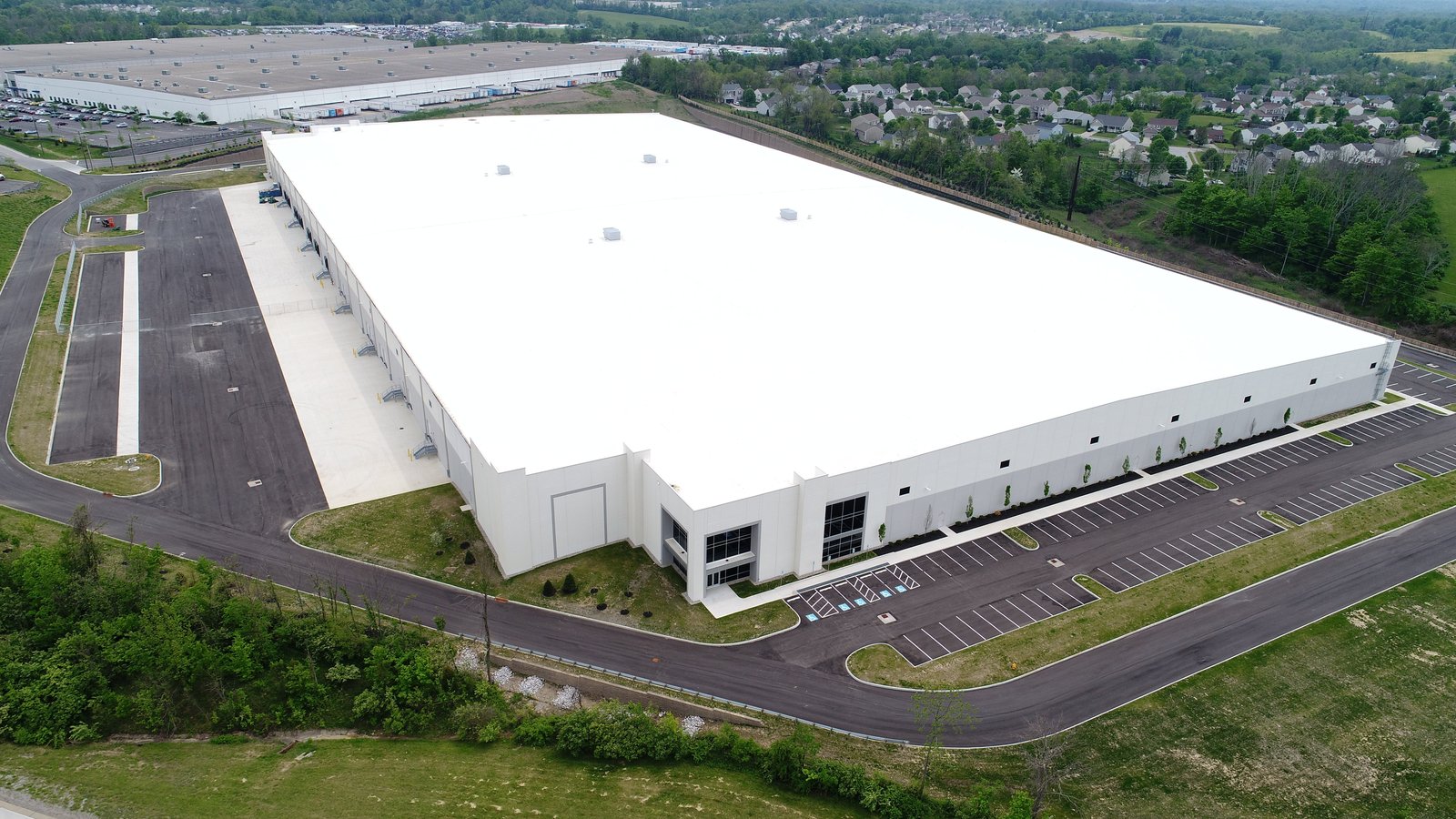
For a truck terminal or cross-dock, the site plan is the product. We draw the trailer paths, the parking positions and the dock layout in one drawing, then fit the building to them. A terminal with doors on both long sides needs a deep apron on each, and the building width and slab joints must align with the door spacing.
We test the entry and exit with turning software against the longest trailers the tenant will run, and we confirm queue space so trucks do not stack onto the public road. Lighting, fencing and a guard booth are planned into the design. If a user will fuel on site, the tank pad, containment and fire clearances are part of the first drawing, not a later add.
Scale the building to the lease
We start with the tenant's volume: trailers per day, door turns and dwell time. Those numbers set the door count and the apron depth. Then we choose the structure, either tilt-wall construction for durability and fire resistance or a metal frame where speed and cost are the priority.
When the tenant is not yet known, we design a flexible spec shell: a regular column grid, space for additional doors in the walls and a yard graded for future trailer parking. A flexible shell leases to a wider group of tenants, which helps absorption.
Utilities deserve the same attention. A terminal draws modest power inside the building but heavy lighting load across the yard, and a contractor shop can draw far more. We ask the electric provider for service capacity before the site plan is final, and we locate the transformer where a conduit run does not cross the truck court. Water for fire protection is checked against the fire flow the sprinkler design needs, since a main that serves houses may not serve a warehouse.
Who uses a building like this
Regional logistics and 3PL operators are the clearest match, followed by building material suppliers, equipment dealers and contractors who want a yard and a shop. Each has different needs for height, power and outdoor storage. A 3PL cares about door count and cube; a contractor cares about the yard and the shop; a material supplier cares about covered loading.
We separate those needs in the program, price them individually and help the owner choose which to build first. The decision often depends on which tenant is available and which parcel is open.
The concrete that carries the trucks
A terminal apron is the most abused pavement on the site, and it must be built right. We inspect the reinforced concrete placed at the dock apron, cut joints at the right spacing and seal them, because an unsealed joint lets water reach the subgrade and the apron fails from beneath. Dowels transfer load across joints, and the subgrade is compacted and tested before the pour.
We schedule the interior slab, the dock pits and the building shell together, so one team is responsible for the sequence. That reduces the gaps between trades and keeps the schedule tight. Near Firestone or Fort Lupton, we can mobilize quickly from nearby work.
Describe the fleet
Tell us the number of doors, the trailer types and the parcel. We will return a scope, a schedule and a budget range for a Frederick terminal, distribution building or yard.
Common Questions
Why does the Highway 52 corridor matter for trucking?
It links I-25 to I-76 across Weld County, passing US 287, US 85 at Fort Lupton and I-76 at Hudson. A carrier can reach the north metro and the interstate to the northeast without crossing Denver. We evaluate your route from the site to each of those connection points.
Should I be concerned about the coal-mining history?
It is a reason to do thorough diligence, not a reason to avoid the town. We recommend a geotechnical report and a review of available mine records for any parcel before design. The results guide foundation and slab decisions.
What apron depth do I need for a cross-dock?
It depends on the trailer length and whether doors are on one side or both. A common range is 130 to 185 feet from the dock face to the far edge of the court. We test the actual geometry on the parcel.
Can you build a contractor yard with a shop?
Yes. We build shops with drive-in doors, heated space and storage, along with yard surfaces and fencing. We also plan power for welders and compressors.
How do I compare Frederick to Firestone?
They share the same interchange, so the difference is in the parcel and the town process. We compare access, utilities, review time and cost for the two and give you a one-page summary.