Every dock door is a hole in a building's envelope that has to survive 40 trailers a shift, a Colorado winter and a driver who backs in at an angle. The leveler, seal, bumpers and restraint at each position are small items on the drawings, but they carry the weight of the operation. We install and coordinate dock equipment on the warehouses we build, and we set the concrete pits and embeds so the equipment fits the first time.
The state's freight routes explain the stakes. Interstate 76 serves Sterling through its business loop, which ends at a diamond interchange at exit 125 where US 6 continues east. In Fort Morgan, I-76 meets State Highway 52 at exit 80, and US 34 runs concurrent with I-76 from near Wiggins to Fort Morgan. Trucks coming off those routes arrive in every kind of weather, which is why an exposed dock face on the plains has to be sealed against wind, snow and frost.
Levelers, seals, bumpers and restraints
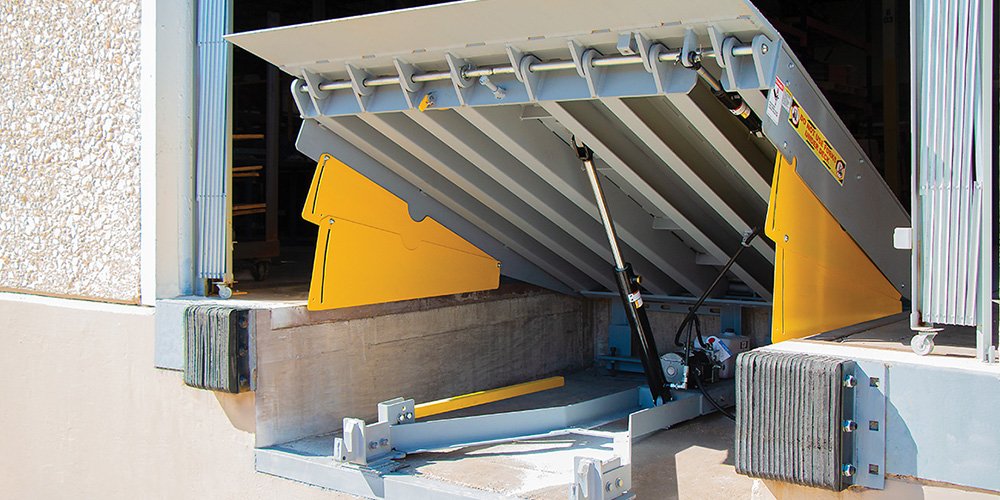
A dock position is a small system. The leveler bridges the gap between the dock floor and the trailer bed, and the common types are hydraulic, mechanical and air-powered units, with nominal capacities often in the range of 30,000 to 50,000 pounds and platform lengths of 6 to 10 feet. Edge-of-dock levelers fit retrofits and light duty, while pit-mounted levelers are the standard for heavy forklift traffic.
Around the leveler sit the bumpers, the seal or shelter, the vehicle restraint and the dock lights. A seal of compressed foam works well for tight, repeatable trailer fits, while a shelter with side curtains suits mixed fleets. Restraints lock the trailer to the dock, which prevents creep, and trailer-presence lights give the forklift driver a go or no-go signal. We assemble these into a single equipment submittal so the pieces from different vendors fit together.
What changes the price of a dock position
Capacity, controls and weather protection set the price. Heavier-duty hydraulic levelers cost more than mechanical ones but need less maintenance and run smoother. A restraint with an interlock to the door and leveler adds cost but improves safety. Insulated leveler pits and thermal breaks cost more up front and pay back in lower heating bills on a cold dock.
Quantity matters. A 100-door cross-dock buys more efficiently than a 12-door distribution shell, but the larger project has more drainage, lighting and pavement to coordinate. We give owners an itemized list with per-door pricing so they can decide where to spend, and we price an extra row of pits with knockouts so adding positions later is affordable. For a view of the whole building, see our distribution center construction page.
Dock safety: restraints, lighting and procedures
Trailer creep and early departure cause some of the worst dock injuries. A vehicle restraint is the first line of defense, and a light communication system gives the driver and the forklift operator the same signal. Guard rails at open dock edges, painted yellow edges and good lighting inside the trailer reduce falls and near misses.
Procedures matter as much as hardware. We turn over operating instructions and a maintenance schedule with each dock package, covering leveler inspection, restraint testing and door service. Greasing, hose checks and annual load tests keep the equipment safe and extend its life, and we recommend a service contract for any busy facility. Spare parts like hoses, lip hinges and seal foam are worth keeping on the shelf, because a dock with a dead leveler loses a door for as long as it takes to get a part.
Setting pits, frames and embeds to tolerance
Dock equipment is only as good as the concrete around it. Leveler pits are formed to the manufacturer's dimensions, with embedded angle frames and anchor bolts cast into the slab, and the pit floor sloped to a drain. If a pit is a half inch out of square, the leveler will bind. We set pit forms with a survey instrument, check them against the shop drawings and brace them before the pour.
On the Front Range, a wet winter and a dry summer both punish dock aprons. The Central 70 Project rebuilt about 10 miles of I-70 between Brighton Boulevard and Chambers Road for $1.2 billion and finished in July 2023, and trucks serving the north Denver industrial belt now cross the corridor on a rebuilt highway, but the apron slab still has to cope with freeze and thaw. We use air-entrained concrete on exterior aprons and slope them away from the building to keep ice off the dock. Denver averages about 49 to 54 inches of snow per year depending on the station and period, so we also leave room on the court for plowed snow to be stacked without blocking a door.
Where dock equipment connects to the rest of the project
The dock wall touches nearly every other scope. The truck court decides how much room a trailer has to swing, and the cross-dock layout configuration decides how many positions you need on each face. If your building is cold, our cold storage scope adds vestibules and rapid-roll doors to the package.
E-470 has interchanges near Brighton and Commerce City with access to I-76, and an interchange in the Brighton area near Henderson with U.S. 85. Owners in the Brighton area plan dock counts around that access, and retail distribution clients in particular choose dock positions that match their store delivery schedules.
Count your doors before the wall is drawn
Send us the dock count, trailer mix and site plan. We will return a pit layout, an equipment list and a per-door budget.
Common Questions
How high should the dock floor be?
Standard dock heights are 48 to 52 inches above the court, which matches common trailer beds. Some operations use a lower height for box trucks or a mix of heights. We confirm the fleet mix first, then set the finished floor and the apron grading to it.
Mechanical or hydraulic levelers?
Mechanical levelers are lower in first cost and simple, but they need the operator to pull a chain or lever. Hydraulic units are push-button, smoother under load and easier on workers. For busy docks, hydraulic is usually the better long-term choice.
Do we need dock seals or shelters?
For conditioned or cold buildings, yes. Seals reduce air infiltration and keep pests out, while shelters suit mixed trailer heights. In unconditioned warehouses, they still protect product from rain and snow.
Can we add dock doors after the building is built?
It is much easier if the slab, wall and pits were planned for it. We can design knockout panels and extra pits in the first build. Retrofitting later means cutting a tilt panel or a metal wall and breaking out slab, which is costlier.
How long is the lead time on dock equipment?
Levelers, restraints and specialty doors can take weeks to months to arrive, depending on the manufacturer and the season. We release the order at contract award and have the shop drawings in hand before pits are formed, so equipment lands on a site that is ready for it.