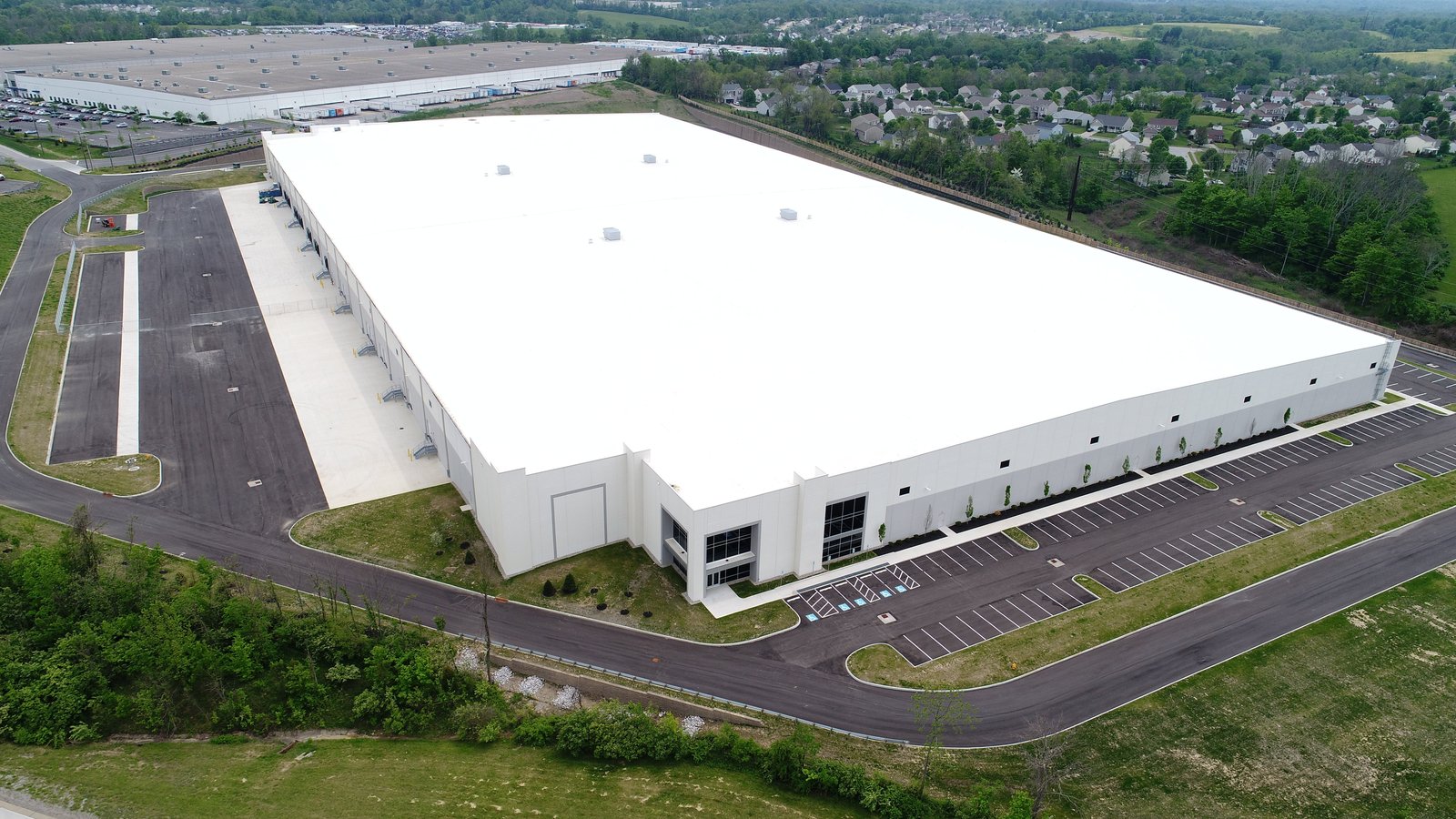
Two freight railroads, one interstate and a 40-acre airport parcel give a Pueblo warehouse more ways to move a pallet than the map first suggests. Interstate 25 and US 85 share one north-south route through the city, US 50 crosses it east to west, and BNSF and Union Pacific both provide freight rail service. For a distribution user that is a short list of questions: which door faces the rail spur, where does the truck court meet the arterial, and how much of the site can be paved before the budget runs out.
We answer them with a building drawn around the freight. That can be a rail-served warehouse with a track-side door line, a bulk building for building products, or a spec shell sized for the next tenant on a park lot. Our work in Pueblo covers the whole package: grading and utilities, the slab, tilt-up or steel erection, the dock package and the yard.
Pueblo's own economic office says commercial and industrial construction here costs about 10 to 15 percent less than the national average, and it lists the St. Charles Industrial Park as an Opportunity Zone with rail freight access. We treat that as a reason to build the right building once, with the slab and the truck court sized for a decade of heavy use.
Heavy industry next door sets the labor and supply picture
EVRAZ Rocky Mountain Steel broke ground on a solar-powered rail mill in Pueblo reported at $500 million, with about 800 construction jobs, about 300 planned permanent jobs and a 240 megawatt on-site solar field. A mill of that scale pulls skilled trades, heavy haul and equipment suppliers into the same labor pool, and it tells a developer that the city's industrial base is a working one.
That base is also a customer for storage. Steel, rail and building-product users need long-length racking, laydown and covered loading, which is why we pair this market with building-products distribution and manufacturing and distribution buildings in our planning. A site selector comparing Pueblo to the Front Range should weigh construction cost, labor draw and rail access together, not one at a time.
What we manage most closely
We supervise and inspect the structural concrete that decides how a warehouse ages: footings, tilt-up panels, slab-on-grade and the dock aprons. A concrete floor that carries loaded forklifts all day needs control joints cut at the right time and a curing plan that survives a Pueblo summer wind. Our industrial concrete floors work is where that planning starts.
Close trade coordination also keeps the schedule honest. When one team schedules the crews that place the slab and set the panels, the casting bed, the lift sequence and the crane path are one conversation. On a site with a steel mill nearby competing for the same trades, that control matters, and it is the same control we bring to crane-ready industrial buildings where the runway beams set the schedule.
Rail spurs, truck courts and what a site actually needs
A rail spur changes everything downstream. Track grades, switch locations, curve radius and the clearance between track and building face are fixed by the railroad's standards, so the building's long dimension and its dock layout follow the track. We draw rail, truck and employee routes as three separate systems so a locomotive never crosses a pedestrian path.
Not every user needs rail. For those who only want an interstate-and-US 50 location, including the lots out in Pueblo West, we put the money into truck court depth and trailer parking rather than a track, and we leave room for a future spur if the site is adjacent to one. That optionality is cheap to design and expensive to retrofit.
Permits, codes and a note on verification
Commercial building codes in Colorado are adopted city by city and county by county rather than as one statewide code, so the edition that applies to a Pueblo project depends on where the lot sits. We confirm the current adopted edition with the building department at the start of design, and we state the design basis in writing on the drawings.
The Pueblo Memorial Airport parcel is a good example of why this matters. The city lists the municipal airport as full service, about 5 miles from I-25, with 40 acres available for development. Airport-adjacent ground can bring height limits, lighting and drainage questions that an interstate lot does not, and we raise them at the first meeting.
Buyers who build in Pueblo
Most of our Pueblo work is for owner-operators who ship by rail or heavy truck, 3PLs consolidating regional freight, and developers building spec space on a park lot. Each reads the building differently. An operator talks about door count and rack height. A developer talks about speed and flexibility. A 3PL talks about turns per shift and tenant-change costs.
The PuebloPlex redevelopment organization has taken ownership of over 5,000 acres of former U.S. Army chemical depot land and plans to acquire about 11,000 more for roughly 23,000 acres in total, with destruction of the depot's mustard agent completed in June 2023. We do not assume what will be built there, but a land base of that size is the kind of ground a long-horizon developer watches. Operators who serve the lower Arkansas Valley often pair a Pueblo building with a smaller cross-dock farther east, and we plan for a pairing with La Junta when the freight pattern calls for one.
Working beside active rail and heavy haul
Construction beside an active rail line needs a plan before the first excavator moves: flagging, track-side clearances, and written coordination with the railroad for any work inside its right of way. We keep a site safety plan that treats rail and truck traffic as the dominant hazards, with separate gates for deliveries and for workers.
Tilt-up erection adds its own controls: exclusion zones under suspended panels, bracing inspected before each lift, and wind limits for crane work. Every subcontractor sees the plan before mobilizing.
Tell us where the freight comes from
Send the lot, the freight mode and the door count you need. We will return a sequence, a budget range and the permit questions to settle first.
Common Questions
Can you build a warehouse with a rail spur in Pueblo?
Yes, if the lot has track access. Pueblo is served by BNSF and Union Pacific, and the city lists the St. Charles Industrial Park with rail freight access. We design the building around the track geometry, coordinate with the serving railroad on clearances, and set the dock layout so trucks and rail cars do not conflict.
Is construction really cheaper in Pueblo?
The city states that commercial and industrial construction costs about 10 to 15 percent less than the national average. We treat that as a city claim, not a guarantee for your lot. Soil conditions, utility extensions and the specification you choose still decide your own budget.
What would an airport-adjacent parcel add to the schedule?
Airport ground can add review for building height, lighting and drainage. The city lists 40 acres available for development at Pueblo Memorial Airport. We raise those review items before design is final so they do not surprise the schedule.
Which code edition will Pueblo require?
Colorado adopts commercial codes locally, not statewide. We confirm the city or county edition with the building department and state it on the drawings before pricing.
How do you handle competition for trades from the steel mill project?
We confirm trade partner availability first and buy out long-lead and trade packages early. We also keep a second source for key trades so one competing project does not stall the schedule.
How wide should the truck court be for a Pueblo distribution building?
It depends on trailer length and the dock layout, but 130 to 185 feet of apron and maneuvering depth is common for 53-foot trailers. We confirm with the civil engineer against your actual trailer fleet.